How Nature Repeats Sacred Geometry
Three mathematical symmetries shared across raw mineral lattices and living botanical or biological forms — paired with structural blueprints, symmetry point groups, and archival mineral palettes.
PLATE I · 60° · 120° HEX PACKING
Hexagonal Symmetry & Close Packing
Whenever identical units pack densely in a plane or minimize boundary energy, 120-degree triple junctions emerge automatically — turning both silica tetrahedra in quartz and warmed beeswax cells into six-sided prisms.
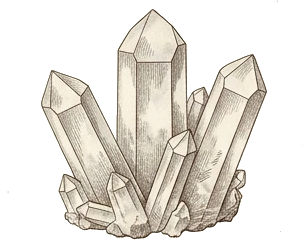 Mineral Lattice
Quartz Prism
Six-sided SiO₂ crystal lattice
Helical chains of corner-sharing silicon-oxygen tetrahedra grow slowest perpendicular to the six prism faces, preserving crisp 120° interfacial angles regardless of crystal size.
60° · 120° HEX PACKING
∠ = 120° · min(P / √A)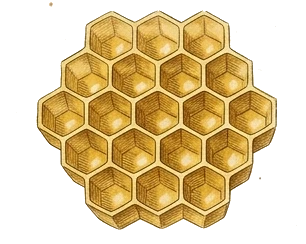 Living Twin
Beeswax Comb
Maximum volume, minimum wax
Honeybees sculpt cylindrical wax cells that soften at hive temperature (35°C) and relax via surface tension into hexagonal prisms — the exact minimum-perimeter tiling proven by the Honeycomb Conjecture.
PLATE II · 137.5° GOLDEN SPIRAL
Spirals, Growth Rings & Phyllotaxis
Sequential accretion from a central meristem or fluid source naturally produces self-similar rings and opposing Fibonacci spirals — preventing overlap in pine scales while preserving rhythmic chemical waves in copper ore.
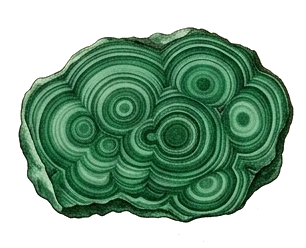 Mineral Lattice
Banded Malachite
Concentric botryoidal copper bands
Periodic precipitation of copper carbonate from mineral-rich water builds radiating fibrous needles layer by layer, recording shifts in trace chemistry as emerald bullseyes.
137.5° GOLDEN SPIRAL
θ = 360°(1 − 1/φ) ≈ 137.508°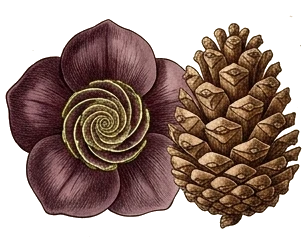 Living Twin
Hellebore & Pine Cone
Fibonacci botanical spiral
New primordia emerge at the golden angle (137.508°) around the growing tip, packing seeds and petals into interlocking clockwise and counterclockwise Fibonacci spirals (8:13 or 13:21).
PLATE III · 6-FOLD & CUBIC AXES
Radiant Crystal & Dendritic Axes
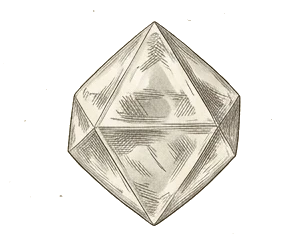
At atomic scale, directional covalent and hydrogen bonds dictate strict angular corridors — carving octahedral facets deep inside Earth’s mantle and six-armed frost stars high inside winter clouds.
 Mineral Lattice
Rough Diamond
Natural octahedral crystal habit
Each carbon atom bonds tetrahedrally to four neighbors in a face-centered cubic lattice, exposing eight mirror-bright {111} triangular planes when crystallized slowly under mantle pressure.
6-FOLD & CUBIC AXES
m3̄m (Octahedral) · 6/mmm (Ice Ih)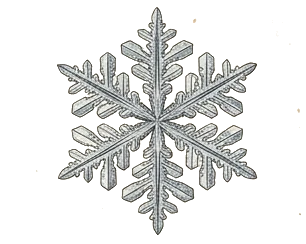 Living Twin
Six-Fold Frost
Atmospheric 60° ice dendrite
Water molecules lock into hexagonal hydrogen-bonded rings (Ice Ih); as a falling crystal passes through shifting humidity and temperature zones, all six corners experience the same history simultaneously.
From Geometry to Material & Pigment
Explore NURBS Surfaces, Crystal Palettes & Botanical Forms
Inspect parametric curves in Morphologium’s Geometry Atlas, translate mineral structures into room palettes on Chromologium, or study living specimens in Herbologium.